
Epicenter Orchard
Saturday, October 17th.
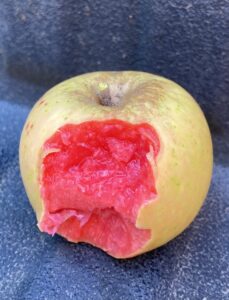
We’re definitely moving on in the season. Allen’s Everlasting is taking its time coming in. It will be in the apple tasting boxes with limited quantities in bulk. More on the way for next week, but really, I expected it to open up by now, and it just isn’t ripening. Stardust is continuing to be really good, both texture, and flavor. Sierra Beauty will take Belle de Boskoop’s place as star baking apple in the lineup. Bright and strong, it is a great eating apple as well. Ruby Tuesday is in good form, but will sellout early. Such a unique and delicious pink-fleshed apple, neither acidic nor boring, It’s bubblegum/berry flavor will charm even the most stubborn apple phobe. Calville Blanc will continue this week. Subtle sweet tart flavor, great for baking, Tart au Pomme, eating out of hand, this ancient french apple painted by Monet, known since the late 1500s will make its case for being valued for another 400 years. Rubaiyat is a deep pink-fleshed fruit that is sharp and bright earlier in the season, perfect for featuring in a pie, but now its sugar is starting to accumulate, which makes for a bold and delicious eating experience. Brushy Mountain Limbertwig is coming into its prime. Rich and interesting, vanilla and slight citrus, with a super crisp texture, this is the gateway apple to venture from supermarket to Epicenter. VIP is the big one for this week. Intense candy fruit punch flavor, and cheery pink flesh hidden under a pippin-looking green skin. Great to eat fresh if you like a strong, sharp flavor, fabulous roasted or baked. Winston, which is a cox’s orange pippin seedling, will be on offer, as will Katherine, the apple Albert Etter called his favorite.
We will have no pears. Our season is over for them. We’re sorry too!
Our dry-farmed heirloom tomatoes will be making a token appearance, maybe the last of the season. Solar Flare, Cherokee Purple, Prudence purple, Porkchop, Black Krim, Amana Orange, Dr. Wychees, Thesaloniki, Chocolate Vintage; hard to keep them straight! It’s definitely okay to just grab the colors you like.
Avocados for this week will be the lovely Lamb Hass.
We’ll have Meyer lemons.
We will also have tasting boxes: 12 exceptional apples, with history and description key, for $25
https://santacruzfarmersmarket.org/markets/westside/
About our operation
Our orchard in Larkin Valley was planted in 2005, as an outgrowth of a runaway hobby/obsession with apples that hasn’t quite run its course. The land was a wet meadow-turned orchard in the 1920s, became a horse pasture in the 60s, reverting to wet meadow in the late 80s. It lies along the bottom of a narrow north-south running valley, bordered on both sides by walls of redwood and oak. Up watershed a rangy tangle of willows divides it from hundreds of acres of rolling wild land.
Ours is a little one-and-a-half acre plot on the edge of a huge block of fairly pristine native habitat that supports a lot of wildlife. We see cougars, coyotes, foxes, bobcats, deer, wild turkeys, eagles, cooper’s hawks, red tailed and red-shouldered hawks, 3 kinds of owl, and lots of gophers. We can trap the gophers, and fence out the deer, but the coyotes are smart. They help with the gophers, but love pears a little too much. A battery of perches and boxes turn the bluebirds, swallows, chickadees and raptors into charismatic farm laborers.
Deep distrust of synthetic chemicals leads me to reject them on my farm and elsewhere in my life, but we do use OMRI listed pheromone ties against codling moth. No synthetic fertilizers or pesticides, no sulphur, copper, neem, or dormant oil, as all these agents kill unintended, innocent organisms. We spray calcium and manganese to help with calcium deficiency in some varieties, use mountains of composted tree chips to conserve water and suppress weeds, and apply occasionally some composted animal manure for fertility. We don’t plow or disc between our rows, using instead a walk-behind high-weed mower to maintain a year-round mixed grass/weed/flower cover instead. What this means is we spend a lot of time crawling our rows, hand weeding to keep the bindweed from swallowing our trees.
Getting down to the apples, we try to grow European style, high flavor types that nobody’s ever heard of unless maybe they happen to be an apple geek, from Europe, or had occasion to haunt their farmers markets. These differ from the commodity varieties like Gala, Fuji, Cosmic Crisp, and could never be confused with a sweetened jicama. They’re busting with acidity, aromatics, even a little astringency to complement their high sugar, making for an intense, complex, high-impact eating experience.
An example of what I mean is the Karmijn de Sonnaville apple from the Netherlands. This is an apple so distinctive in flavor, that it destroys past concepts of what an apple is supposed to taste like. Sugar, acidity, aromatic components in such opulence, it illuminates the fundamental short-coming of conventional apple varieties. Big flavor is composed of acid, aromatics, astringency, even some bitter elements (think cherries). These compliment the sugar, filling-out, complicating, and defining the apple’s flavor so it’s more than the watery sweet crunch that we have grown so familiar with in commercial apples.
The reason store bought apples all seem to share that same boring taste profile is functional. When you pick an apple at full ripeness, it doesn’t store for long periods without deteriorating and becoming mealy, bland and mushy. So if an apple must store in good shape for a year to be considered marketable (as the industry currently demands) then it must be picked young. That’s not something you can pull off with a full-flavored apple. A young heirloom type will have low sugars, high tannins and acid, and underdeveloped aromatics. If there are bitter elements in there that high sugars would mask or turn into an asset, they will be up front and objectionable. In short, a richly flavored apple harvested for maximum storage potential will fall far short of its flavor potential, and nobody would want to eat it.
A modern commercial variety will taste about like itself if picked young, just a little less sweet. So in the search for new apple varieties (think CosmiCrisp, EverCrisp), there is a premium placed on long storing, mild flavored, early coloring, high-sugar types that can be picked and eaten at that crucial early stage of maturity, without sacrificing much flavor potential (because that potential is low to begin with), but hold their texture for twelve months in cold storage, so they can retain their place in the grocer’s displays.
The industry’s emphasis on crispness and sweetness are the only two cards they have to play with in their deck. This narrow focus comes at the direct expense of flavor. We believe there is a place for this kind of indestructible apple, especially having grown up in the age of the mushy, bland and ubiquitous Red Delicious apple. That era served as a powerful training ground, establishing an almost universal hatred for stale storage apples. Cosmic Crisp hasn’t much flavor, but it can never be called mushy, and people are happy about that.
Our strategy for avoiding the musty, end-stage storage apple is the opposite. We choose powerfully flavored apples, pick them ripe, at near their peak flavor, and sell them directly to the public while they are crisp, juicy and fresh. We’ve seen how our varieties destroy the commercial types in side-by-side comparisons. Our annual apple tasting event at Wilder Ranch pits 75+varieties against each other, and rarely does a commercial type place within the top twenty.
This approach has led us to explore ever more widely for varieties that people not only like, but react passionately to. Expect to encounter apples you will never see anywhere else. Expect them to pop up in their peak season and disappear from our stand when that time has passed.
We have grown around 300 different varieties of apples over the past 35 years, but we distill-down our market selection to perhaps 30 of our personal favorites. Beyond that, we have been breeding apples for flavor since 2005. Our Royal Blush, Ruby Tuesday, Code Pink, VIP, Hauer’s Gold, Crabby Lady, Pineapple Candy and Pineapple Crunch varieties are fixtures at our stand, redefining the standards of apple flavor with their high sugar and wild mix of berry/pineapple/grape/rose notes.
We at Epicenter are thrilled to be able to play with a full deck, and explore the entire range of apple flavor-potential, unrestrained by mass marketing limitations.
Not everyone shares our preferences. Some people are so used to supermarket apples, they feel disoriented, affronted by bold flavors. Luckily for them, there are many places to buy normal type apples. After 25 years of running public apple tastings, we’ve seen that there is a solid segment of the population who responds to high-flavored apples, and we feel relieved and delighted to target those who share our sensibilities. It’s a resonant experience to provide the kind of fruit we love directly to the people who are thirsting for it. Spend a minute in our stand and you’ll feel it. We hope to continue to attract an ever-growing and enthusiastic following of avid apple-lovers who will further enable our behavior.
Since farming is all about enormous amounts of sometimes boring, often repetitive, mostly difficult and obscurely technical labor, if we didn’t love the process of discovering and producing great fruit, and weren’t thrilled to see our customers light-up over it, all that bother would feel a little bit stupid.